Table of Content
Next, we compared absolute humidity to RH and dew point and learned how to control moisture levels in the house. A digital hygrometer is easy to find and will monitor your home’s moisture level so you can be proactive about creating a relaxing environment. We like this ThermoPro digital hygrometer because it’s easy to read and reports your home’s indoor temperature and humidity level. Plus, the comfort indicator will let you know if you’re approaching a temperature or humidity level outside your desired settings. If you want to measure your home’s humidity you’ll need a hygrometer. A hygrometer is used to measure the humidity level in your house.

If your laundry room happens to be in the basement, make sure the dryer is properly vented to the outside. Exhaust fans should also always be used in bathrooms and kitchens to keep humidity at bay. Or, before doing that, you might get a dehumidifier to help dry it out. The ideal moisture range for your basement is anywhere between 30-50%, although there’s some wiggle room with this average.
A Factual Guide on the Ideal Humidity for Your Home in Winter
For the cherry on top, low humidity can actually impact the foundation of your home. When wood gets too dry, it cracks and splinters, which can damage structural integrity. 21% of the annual, reported cases of asthma can be attributed to mold and damp indoor air. If you have asthma or allergies, high humidity levels can exacerbate your symptoms. Think you can stand to live more comfortably this summer?

Your wood is going to stay sturdy and strong, and your family isn’t going to turn into sweaty bog-monsters, which sounds like a win-win to us. Humid summer weather, on the other hand, can also create annoyances. Mould and dust mites thrive in more humid environments - and both create problems for allergy and asthma sufferers. Plus, we all know how uncomfortable heat and humidity are when they’re combined . The lifetime of dehumidifiers usually ranges from five to 10 years.
Humidity-Related Terms To Know for Indoor Spaces
During winter months or the cool season, use a humidifier for dry air. During summer or warmer climates, use a dehumidifier to carry out moisture. Water leaks follow gravity and gradually make their way down into the basement when left unrepaired. The havoc that a neglected water leak can have on humidity levels is tremendous, not to mention providing an environment for mold and mildew to feast upon.
The same is true for bathroom fans, refrigerators, and food processors. Essentially, a humidifier is a device that sprinkles the area with water, increasing humidity levels in the atmosphere. One single unit won’t be able to handle a big house, but if you put it in an average-sized room, you’ll be impressed by its performance. Houseplants are also known to increase humidity, but only by a small amount.
Too-low and too-high moisture ranges can impact your health and sleep patterns.
The benefit of opting for a whole-home humidity control system? It will automatically measure indoor humidity levels and make the necessary adjustments so the level in your home remains between 40–60%. Whole-home humidifiers and dehumidifiers will set your space up for the perfect indoor humidity range. As the seasons change, so do the conditions in your home. For that reason, humidity becomes trapped, causing a sticky feel in the air. Unfortunately, this can breed mold and mildew growth and lead to uncomfortable skin and allergy symptoms.
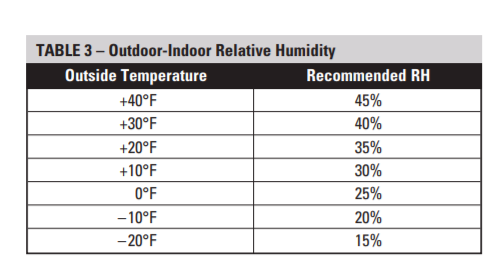
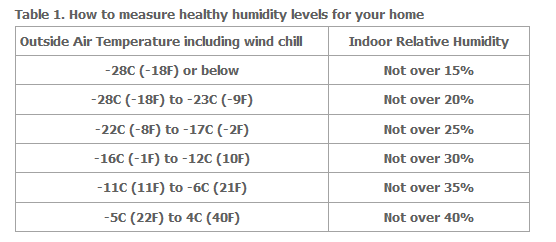
For those with existing conditions, asthma or allergies, humidity control is particularly important. Most indoor air quality experts believe that the ideal humidity for a home in winter is 35% to 50%. Any humidity level that’s in excess of 60 percent has the potential to give you certain health issues — apart from making your living space uncomfortable. Having air that is too humid can encourage dust mites and pest infestations and can make your home a breeding grounds for mold and mildew. Conversely, when the air is too dry, you’re more susceptible to colds, respiratory illnesses, dry skin, dry hair, and even cracked furniture. The happy medium for relative indoor humidity is 40–60%.
This article is an effort to define the ideal indoor humidity, which is a necessarily debatable figure due to multiple variables and the subjectivity of comfort. However, it does help to look at general comfort ranges. We include a chart of the relationship between humidity and comfort, as well as an infographic of humidity levels information. You’ll find that your basement has a lower humidity level in the winter when it’s colder outside, and there’s less humidity in the air.
The range in which optimal indoor humidity is achieved is, thankfully, quite broad. If you’re getting a reading somewhere between 30 and 60%, you’re in pretty good shape. That being said, it can prove to be tricky to maintain such levels, so constant monitoring is a good idea. This can be done by way of a hygrometer, which can be purchased online for under a tenner.
You’ll get 60 hours of operation time from this unit when it’s set to the lowest mist setting. The Levoit humidifier modifies the humidity level in rooms up to 753 square feet, but if you have a smaller space, check out our list of best portable humidifiers. It is the right product to help control or reduce your home’s indoor humidity levels by pulling moisture out of the indoor air and spitting cooler air back out. In addition, it can also contribute to energy saving with its relation to the use of the HVAC system.
This will remove a lot of the trapped moisture and allow you to let other nasties, such as Volatile Organic Compounds , to escape as well. Very high readings are considered to be anything above 70% humidity, while low humidity is anything below 25%. These should be addressed regardless of the time of year.
It is a level that you will also be comfortable in when you are sleeping. The right humidity is an integral factor when it comes to comfort in our bedrooms. One may then ask what is a good humidity level for a bedroom? One that gives you comfort when breathing is the required level of humidity. Luckily, you don’t have to live with high humidity indoors.
Another helpful way to decrease basement humidity is by increasing ventilation. Moisture in the air is attracted to the cool surfaces of a basement. If you live in a rainy area, it’s common for basements to absorb the water soaked into the ground from rainwater into the basement through the porous concrete. Furthermore, basements tend to hold more humidity than the rest of the house because they’re cooler and underground, which means less ventilation and air exchange. However, a basement getting too dry in the winter doesn’t happen near as often as basements that get too humid during the hotter summer months.
For many reasons, basements tend to be the area of the house that retains the most moisture. Other common issues include static electricity, chipping of paint, and even damage to expensive electronics. Allow bathwater to cool in the tub before draining it to release moisture into the air. Increased energy bills as you turn down the temperature on the thermostat for relief from the humidity. Visible condensation on windows and walls that can produce a feeling of mugginess throughout the home. Humidity levels that are below 40% or above 60% tend to present issues that may negatively affect your home environment.


No comments:
Post a Comment